

🩸 The Hidden Risk: Why a “Quick Wipe” Isn’t Enough
By Premises Management Group Surrey (PMGS)
A nosebleed. A minor accident. A small spill.
In many environments, the response is immediate and well-intentioned — grab some tissue, disinfect the surface, and carry on.
Problem solved… or so it seems.
The reality is far more complex — and potentially far more dangerous.
⸻
⚠️ What Are Blood-Borne Pathogens?
Blood-borne pathogens are microorganisms present in blood that can cause disease in humans. The most commonly known include:
- Hepatitis B (HBV)
- Hepatitis C (HCV)
- Human Immunodeficiency Virus (HIV)
These pathogens are not visible to the naked eye, and their presence is not eliminated simply because a surface looks clean.
⸻
⏳ How Long Can They Survive?
One of the most overlooked risks is survivability.
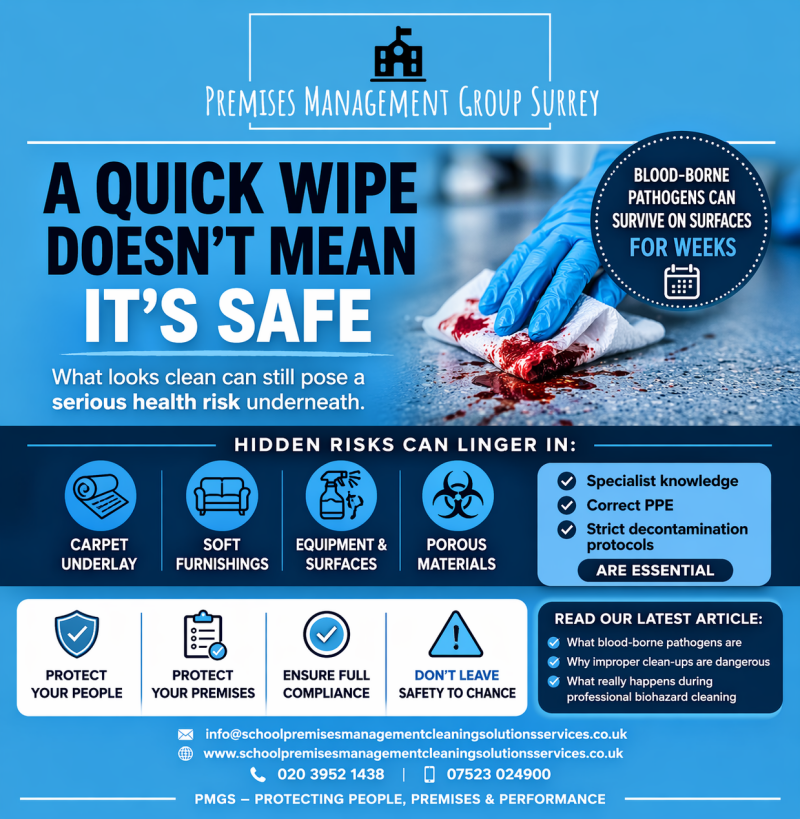
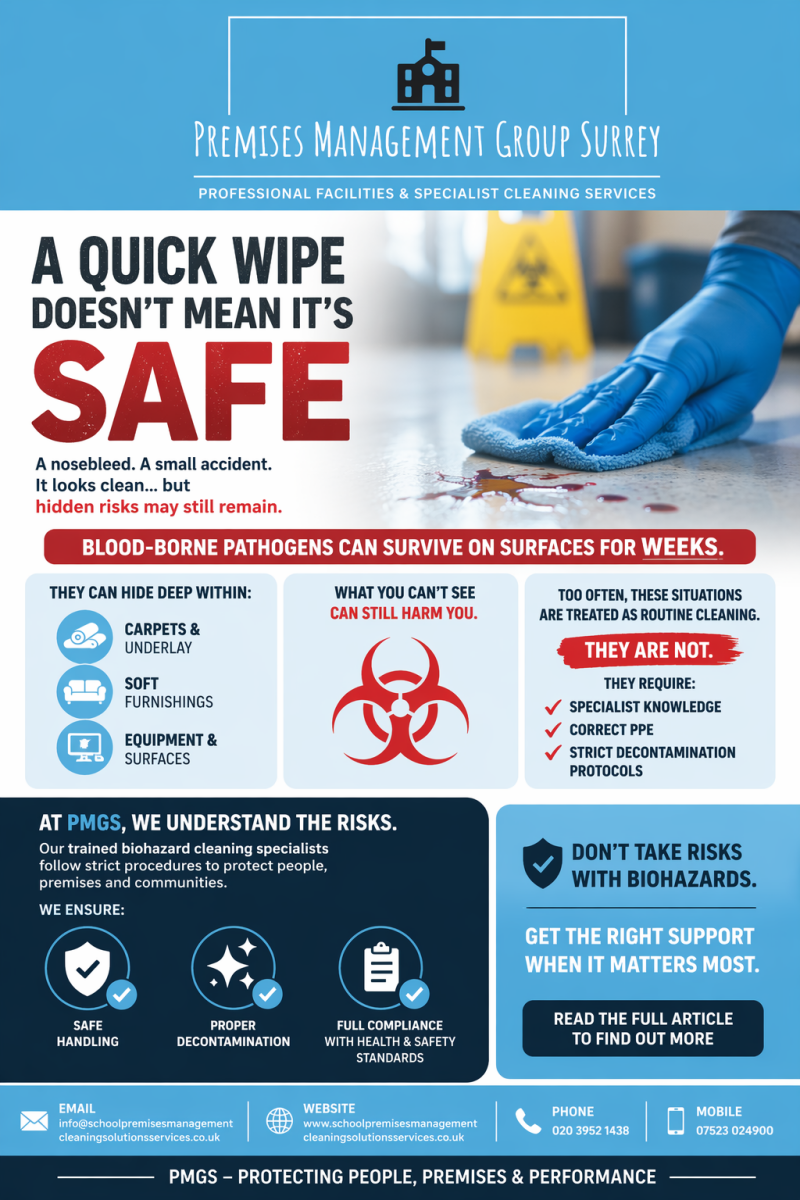
Certain blood-borne pathogens can remain viable on surfaces for days — even weeks, depending on environmental conditions.
This means that:
- A surface cleaned incorrectly can still pose a risk
- Contamination may spread through touch points
- Individuals may be exposed long after the initial incident
⸻
🧱 The Hidden Danger Beneath the Surface
Modern facilities are filled with porous materials, including:
- Carpets and underlay
- Upholstered furniture
- Soft furnishings
- Equipment with textured surfaces
These materials can absorb fluids, allowing pathogens to penetrate beneath the visible surface.
A quick wipe may remove what you can see —
but not what has already been absorbed.
⸻
❌ The Problem with “Routine Cleaning”
Too often, incidents involving blood are treated as standard cleaning tasks.
This approach creates several risks:
- Incomplete decontamination
- Cross-contamination to other areas
- Exposure to unprotected staff or occupants
- Failure to meet health & safety compliance standards
In environments such as schools, workplaces, and public facilities, this is not just poor practice — it can have serious consequences.
⸻
🧤 What Proper Biohazard Cleaning Requires
Effective biohazard cleaning is a controlled process, not a quick reaction.
It involves:
✔️ Risk Assessment
Understanding the extent of contamination and affected materials
✔️ Correct PPE
Gloves, protective clothing, and sometimes respiratory protection
✔️ Specialist Cleaning Agents
Hospital-grade disinfectants designed to neutralise pathogens
✔️ Decontamination Protocols
Systematic cleaning, disinfection, and safe disposal of contaminated materials
✔️ Waste Management
Compliant disposal of biohazardous waste in accordance with regulations
⸻
🏫 Why This Matters in Real Environments
In schools, offices, and shared spaces, the stakes are higher:
- High footfall increases the risk of spread
- Vulnerable individuals may be present
- Surfaces are frequently touched and reused
A single improperly handled incident can lead to wider contamination across a site.
⸻
🛡️ The PMGS Approach
At Premises Management Group Surrey (PMGS), we approach these situations with the seriousness they require.
We focus on:
- Protecting people
- Safeguarding environments
- Ensuring full compliance with health & safety standards
Our approach is not about making something look clean.
It’s about ensuring it is safe, verified, and properly decontaminated.
⸻
📌 Final Thought
Cleaning is often seen as a surface-level task.
But when it comes to biohazards, what you can’t see is what matters most.
A quick wipe may restore appearance —
but only proper procedures restore safety.
⸻
📣 Call to Action
If you manage a facility, oversee cleaning, or are responsible for health & safety:
👉 Make sure your processes go beyond appearance
👉 Ensure staff are trained and protected
👉 Use professional support where required
Because when it comes to biohazards —
there is no room for assumption.
⸻
PMGS – Protecting People, Premises & Performance
📧 info@schoolpremisesmanagementcleaningsolutionsservices.co.uk
🌐 www.schoolpremisesmanagementcleaningsolutionsservices.co.uk
Add comment
Comments