

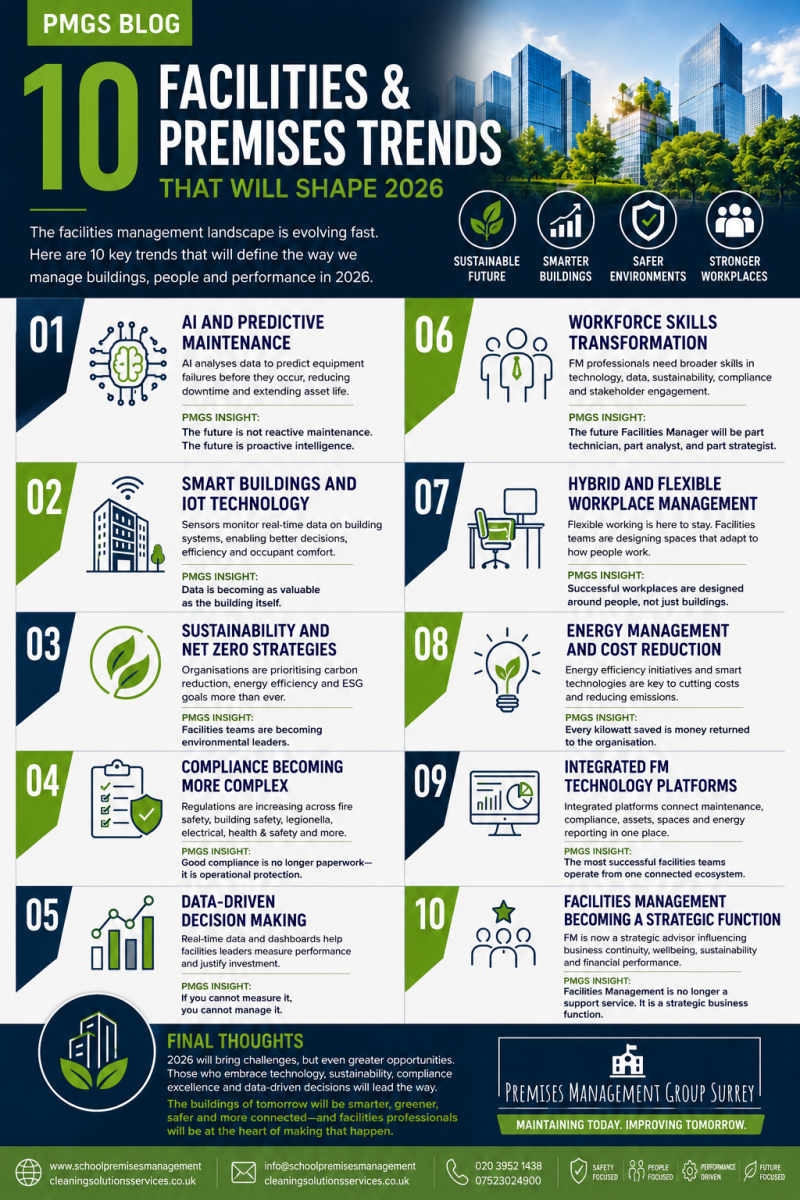

🔟 Facilities & Premises Trends That Will Shape 2026
By Peter Davies – Founder & CEO, Premises Management Group Surrey (PMGS)
The facilities management industry is evolving faster than ever before. As we move through 2026, premises professionals are expected to do far more than simply maintain buildings.
Today’s facilities teams are becoming strategic leaders, responsible for sustainability, compliance, workplace experience, asset performance, and data-driven decision-making.
Here are 10 key facilities and premises trends that will shape the future of our industry in 2026.
⸻
1. Artificial Intelligence (AI) and Predictive Maintenance
The days of waiting for equipment to fail are rapidly disappearing.
AI-powered systems can now analyse data from building systems, identify patterns, and predict failures before they occur. This allows facilities teams to intervene earlier, reducing downtime and extending asset life. Predictive maintenance is becoming one of the most significant investments across the FM sector.
PMGS Insight:
The future is not reactive maintenance. The future is proactive intelligence.
⸻
2. Smart Buildings and IoT Technology
Buildings are becoming smarter.
Sensors are now monitoring:
- Temperature
- Air quality
- Occupancy
- Energy consumption
- Equipment performance
This real-time information enables facilities teams to make better operational decisions while improving efficiency and occupant comfort.
PMGS Insight:
Data is becoming as valuable as the building itself.
⸻
3. Sustainability and Net Zero Strategies
Environmental responsibility is no longer optional.
Schools, businesses, and public sector organisations are under increasing pressure to reduce carbon emissions, improve energy efficiency, and meet ESG objectives.
Facilities managers are now playing a leading role in delivering sustainability goals through smarter building management and energy reduction initiatives.
PMGS Insight:
Facilities teams are becoming environmental leaders.
⸻
4. Compliance Becoming More Complex
The compliance burden continues to increase.
Areas receiving greater scrutiny include:
- Fire safety
- Building safety
- Legionella control
- Electrical compliance
- Health & Safety
- Emergency preparedness
Organisations are investing heavily in digital compliance management systems to ensure audit readiness and legal compliance.
PMGS Insight:
Good compliance is no longer paperwork—it is operational protection.
⸻
5. Data-Driven Decision Making
Facilities leaders are increasingly expected to justify spending through measurable outcomes.
Key metrics include:
- Asset performance
- Energy usage
- Occupancy rates
- Maintenance backlogs
- Response times
- Lifecycle costs
Organisations are shifting towards real-time dashboards and centralised data platforms to improve visibility.
PMGS Insight:
If you cannot measure it, you cannot manage it.
⸻
6. Workforce Skills Transformation
The modern Facilities Manager requires a broader skillset than ever before.
Tomorrow’s FM leaders will need expertise in:
- Technology
- Data analytics
- Sustainability
- Compliance
- Stakeholder engagement
- Project management
The sector is increasingly seeking digitally skilled professionals who can bridge operations and technology.
PMGS Insight:
The future Facilities Manager will be part technician, part analyst, and part strategist.
⸻
7. Hybrid and Flexible Workplace Management
Although many organisations have increased office attendance requirements, flexible working remains a permanent feature of modern workplaces.
Facilities teams are adapting buildings to support:
- Flexible occupancy
- Shared workspaces
- Occupancy monitoring
- Enhanced workplace experiences
Understanding how spaces are used has become a major operational priority.
PMGS Insight:
Successful workplaces are designed around people, not just buildings.
⸻
8. Energy Management and Cost Reduction
With energy costs continuing to challenge budgets, facilities teams are focusing heavily on efficiency.
Key initiatives include:
- LED upgrades
- Smart HVAC controls
- Energy monitoring systems
- Demand management technologies
Energy management is increasingly viewed as one of the largest opportunities for operational savings.
PMGS Insight:
Every kilowatt saved is money returned to the organisation.
⸻
9. Integrated FM Technology Platforms
Many organisations still operate multiple disconnected systems.
In 2026, the trend is towards integrated platforms that bring together:
- Maintenance management
- Compliance
- Asset tracking
- Space management
- Energy reporting
This creates a single source of truth and improves decision-making across entire estates.
PMGS Insight:
The most successful facilities teams operate from one connected ecosystem.
⸻
10. Facilities Management Becoming a Strategic Function
Perhaps the biggest shift of all is the changing perception of facilities management.
Facilities professionals are no longer viewed simply as caretakers or maintenance providers. They are becoming strategic advisors who directly influence:
- Business continuity
- Sustainability
- Employee wellbeing
- Operational resilience
- Financial performance
The FM profession is moving from the plant room to the boardroom.
PMGS Insight:
Facilities Management is no longer a support service. It is a strategic business function.
⸻
Final Thoughts
2026 will continue to challenge facilities and premises professionals, but it will also create enormous opportunities.
Those who embrace technology, sustainability, compliance excellence, and data-driven decision-making will be best positioned to succeed.
At Premises Management Group Surrey, we believe the future of facilities management lies in combining traditional premises expertise with modern innovation.
The buildings of tomorrow will be smarter, greener, safer, and more connected than ever before—and facilities professionals will be at the heart of making that happen.
Peter Davies
Founder & CEO
Premises Management Group Surrey
“Maintaining Today. Improving Tomorrow.”
Add comment
Comments