

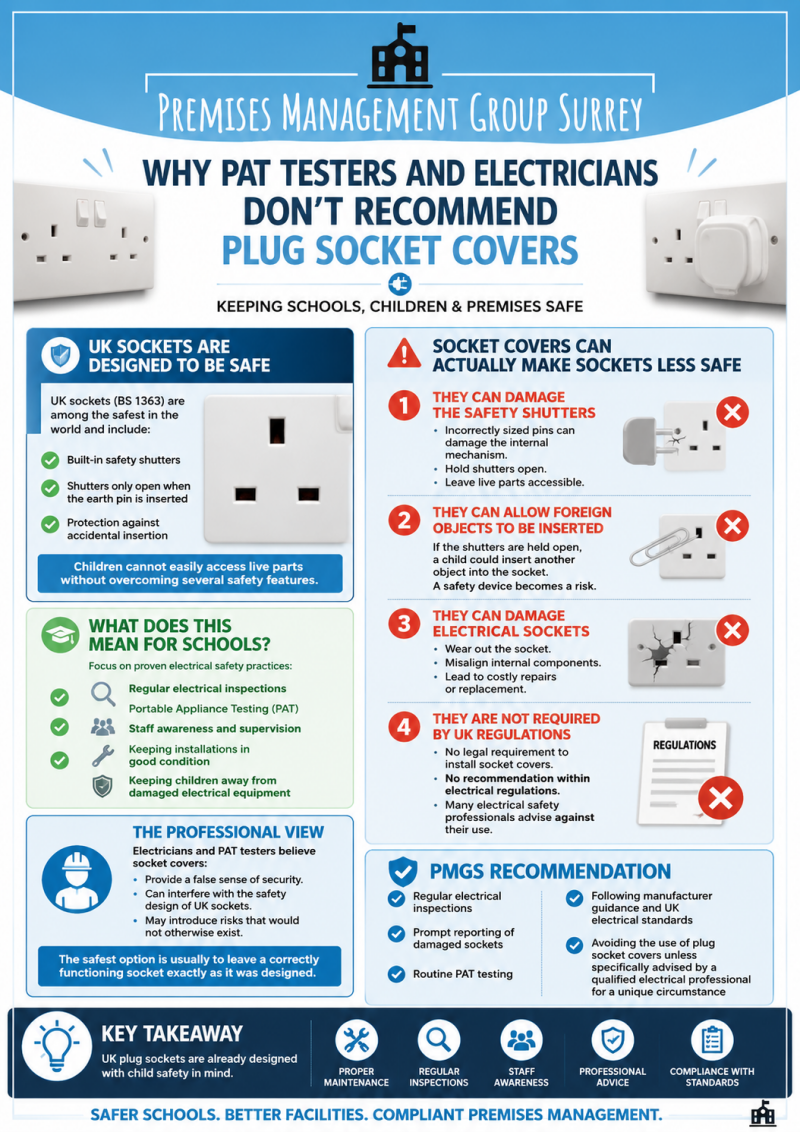
🔌 Why PAT Testers and Electricians Do Not Recommend Plug Socket Covers
A PMGS Facilities Management Blog
By Premises Management Group Surrey (PMGS)
Published By Peter Davies
When it comes to electrical safety, many people believe that plastic plug socket covers make electrical outlets safer, particularly in schools, nurseries, and homes with young children.
However, the surprising truth is that most qualified electricians, PAT testers, and electrical safety organisations do not recommend the use of plug socket covers.
So why is this the case?
⸻
⚡ UK Plug Sockets Are Already Designed to Be Safe
The UK uses the BS 1363 socket system, which is regarded as one of the safest electrical socket designs in the world.
A standard UK socket already includes:
✅ Built-in safety shutters covering the live and neutral contacts.
✅ Shutters that only open when the earth pin is inserted correctly.
✅ Protection against accidental insertion of fingers or objects.
This means that children cannot easily access live electrical parts without deliberately overcoming several safety features.
⸻
🚫 Socket Covers Can Actually Make Sockets Less Safe
Many plug socket covers are not manufactured to the same standards as UK electrical sockets.
Electricians often find that:
1. They Can Damage the Safety Shutters
Some covers have incorrectly sized pins, which can:
- Damage the internal mechanism.
- Hold shutters open.
- Leave live parts accessible.
⸻
2. They Can Allow Foreign Objects to Be Inserted
If a cover leaves the safety shutters open, a child could potentially insert another object into the socket.
Ironically, the device intended to improve safety can actually create a hazard.
⸻
3. They Can Damage Electrical Sockets
Repeated use of poorly manufactured socket covers can:
❌ Wear out the socket.
❌ Misalign the internal components.
❌ Lead to expensive repairs or replacement.
⸻
4. They Are Not Required by UK Regulations
There is:
❌ No legal requirement to install socket covers.
❌ No recommendation within electrical regulations to use them.
Many electrical safety professionals actively advise against their use.
⸻
🏫 What Does This Mean for Schools?
Schools should instead focus on:
✅ Regular electrical inspections.
✅ Portable Appliance Testing (PAT).
✅ Staff awareness and supervision.
✅ Ensuring sockets and electrical installations remain in good condition.
✅ Keeping children away from damaged electrical equipment.
⸻
🔍 The Professional View
Many electricians and PAT testers believe that socket covers:
- Provide a false sense of security.
- Can interfere with the safety design of UK sockets.
- May introduce risks that would not otherwise exist.
The safest option is usually to leave a correctly functioning socket exactly as it was designed.
⸻
📋 PMGS Recommendation
At Premises Management Group Surrey (PMGS), we recommend:
🔹 Regular electrical inspections.
🔹 Prompt reporting of damaged sockets.
🔹 Routine PAT testing.
🔹 Following manufacturer guidance and UK electrical standards.
🔹 Avoiding the use of plug socket covers unless specifically advised by a qualified electrical professional for a unique circumstance.
⸻
💡 Key Takeaway
UK plug sockets are already designed with child safety in mind.
In many cases, adding a socket cover can actually reduce the effectiveness of the built-in safety features.
Electrical safety is best achieved through:
✔ Proper maintenance
✔ Regular inspections
✔ Staff awareness
✔ Professional advice
✔ Compliance with electrical safety standards
⸻
Premises Management Group Surrey (PMGS)
Supporting Safer Schools, Better Facilities, and Compliant Premises Management Across Surrey and Beyond. 🔌🏫⚡
Add comment
Comments