

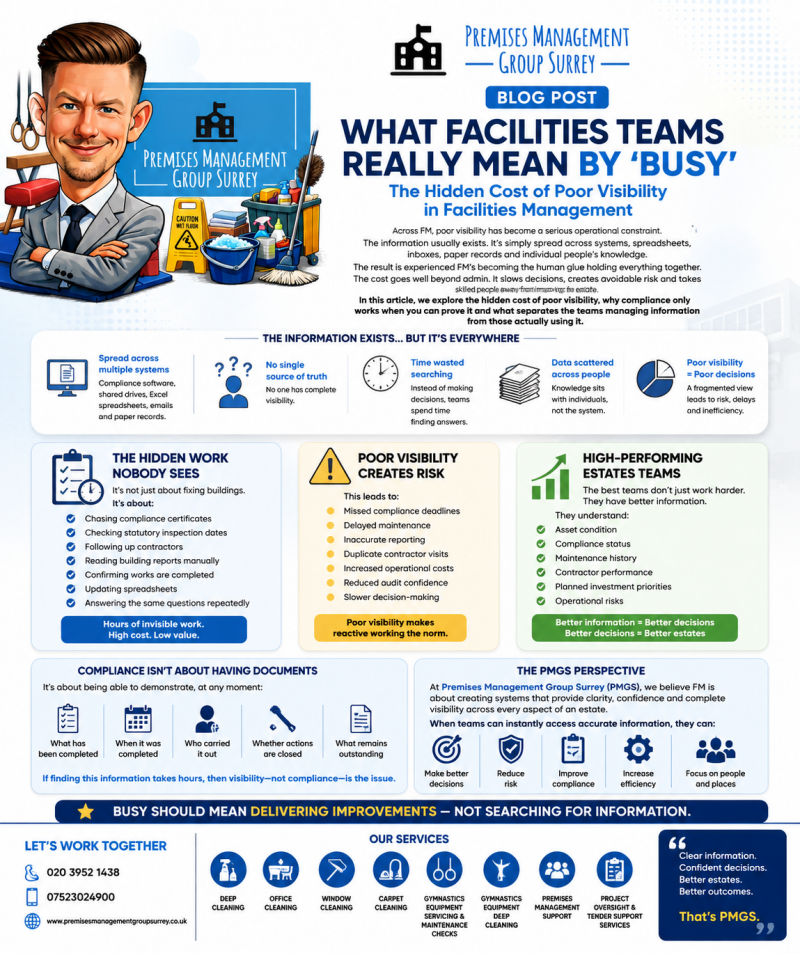
What Facilities Teams Really Mean by “Busy”
The Hidden Cost of Poor Visibility in Facilities Management
By Peter Davies
Founder & CEO | Premises Management Group Surrey (PMGS)
When people ask a Facilities Manager how things are going, the answer is often the same:
“Busy.”
But what does “busy” actually mean?
In many organisations, being busy isn’t simply about carrying out maintenance, responding to emergencies, or delivering improvement projects. Increasingly, it means spending valuable hours searching for information that should already be readily available.
Across the Facilities Management sector, poor visibility has become one of the biggest operational challenges facing teams today.
⸻
The Information Exists… But It’s Everywhere
Most estates teams aren’t lacking information—they’re overwhelmed by where it’s stored.
It could be spread across:
- Compliance software
- Shared drives
- Excel spreadsheets
- Email inboxes
- Paper logbooks
- Contractors’ reports
- Individual team members’ knowledge
When information lives in multiple places, no one has complete visibility.
Instead of making informed decisions quickly, teams spend their time trying to piece together the bigger picture.
⸻
The Hidden Work Nobody Sees
A large proportion of a Facilities Manager’s day isn’t spent fixing buildings.
It’s spent:
- Chasing compliance certificates
- Checking statutory inspection dates
- Following up contractors
- Reading building reports manually
- Confirming whether works have actually been completed
- Updating spreadsheets
- Answering the same questions repeatedly
These tasks rarely appear on performance reports, yet they consume countless hours every week.
⸻
Experienced FM Professionals Become the “Human System”
One of the biggest risks is that experienced Facilities Managers become the glue holding everything together.
They know:
- Where every document is stored.
- Which contractor to contact.
- Which building has recurring issues.
- Which spreadsheet is the latest version.
- Which certificates are outstanding.
While experience is invaluable, organisations should never rely on one person to hold critical operational knowledge.
If that individual is unavailable, retires, or moves on, years of operational understanding can disappear overnight.
⸻
Poor Visibility Creates Risk
This isn’t simply an administrative inconvenience.
It creates genuine operational risks, including:
- Missed compliance deadlines
- Delayed maintenance
- Inaccurate reporting
- Duplicate contractor visits
- Increased operational costs
- Reduced confidence during audits
- Slower decision-making
Ultimately, poor visibility makes reactive working the norm instead of proactive estate management.
⸻
Compliance Isn’t About Having Documents
Many organisations believe they’re compliant because they possess certificates.
But compliance means being able to demonstrate, at any moment:
- What has been completed
- When it was completed
- Who carried it out
- Whether remedial actions have been closed
- What remains outstanding
If finding this information takes hours, then visibility—not compliance—is the real issue.
⸻
High-Performing Estates Teams Work Differently
The strongest Facilities Management teams don’t necessarily have more staff or larger budgets.
They have better information.
They understand:
- Asset condition
- Compliance status
- Maintenance history
- Contractor performance
- Planned investment priorities
- Operational risks
This enables them to spend less time searching for answers and more time improving buildings.
⸻
Technology Is Only Part of the Solution
New software can certainly help.
However, technology alone won’t solve poor visibility.
Successful organisations combine:
- Clear processes
- Accurate records
- Consistent reporting
- Defined responsibilities
- Regular data reviews
- A culture of accountability
Without these foundations, even the most advanced systems become another place where information gets lost.
⸻
The PMGS Perspective
At Premises Management Group Surrey (PMGS), we believe Facilities Management is about far more than responding to problems.
It’s about creating systems that provide clarity, confidence, and complete visibility across every aspect of an estate.
When teams can instantly access accurate information, they can:
- Make better decisions.
- Reduce operational risk.
- Improve compliance.
- Increase efficiency.
- Focus on enhancing the environments where people learn, work, and thrive.
Busy should mean delivering improvements—not searching for information.
⸻
Final Thoughts
The best Facilities Managers don’t simply manage buildings.
They manage information, risk, people, and performance.
In today’s increasingly complex estate environment, visibility has become one of the most valuable operational assets any organisation can invest in.
Because when you can clearly see your estate, you can manage it with confidence.
⸻
Peter Davies
Founder & CEO
Premises Management Group Surrey (PMGS)
Professional Facilities Management | Estates Support | Compliance | Cleaning Services | Specialist Gymnastics Equipment Maintenance
Add comment
Comments